
The reputation of the well-being regions declined again—their reputation as places to work suffered the most
The " Reputation&Trust 2026" survey of well-being regions indicates that the average reputation of these regions has begun to decline after rising last year.
The average reputation score for the well-being sectors has dropped from 2.84 last year to 2.77. There has been a decline in all subcategories of reputation, with the largest drop in the employment subcategory, where the rating has fallen by as much as 0.13 points, from 2.95 to 2.82.
As was the case last year, the weakest category is the economy, whose reputation score of 2.42 places it in the “extremely poor” reputation category. Only the “products and services” category reaches the “moderate” reputation category, with a reputation score of 3.03.
The Average Reputation of Finland's Well-Being Regions
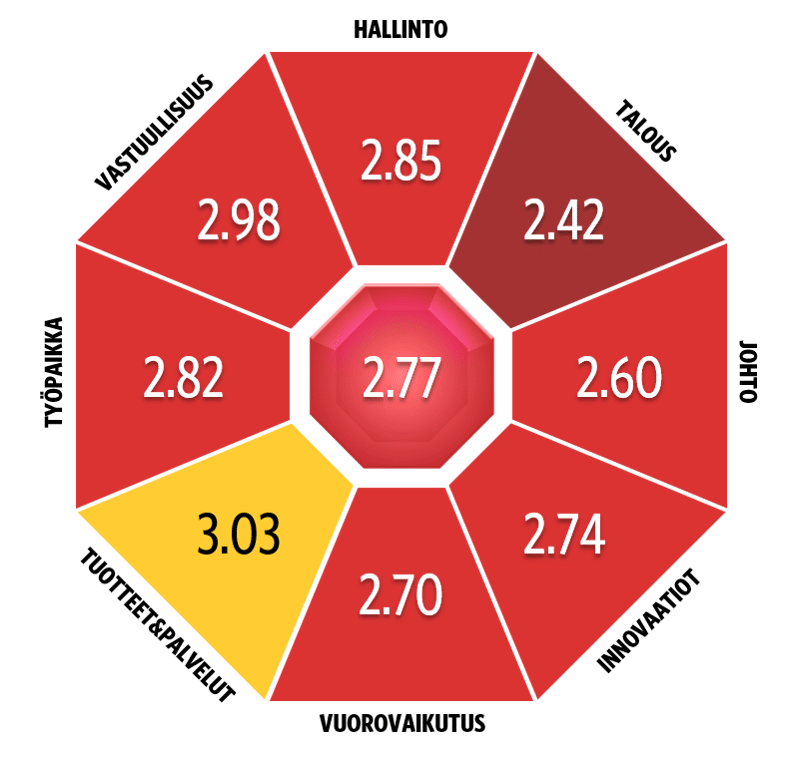
Reputation&TrustAccording to the five-point scale (1–5) of the research model, a reputation is considered moderate if it receives a score of at least 3.00. A score of 2.50–2.99 indicates a poor reputation, and a score of 2.49 or lower indicates a very poor reputation.
“Last year, it already appeared that the overall reputation of the welfare regions was on the rise, but now, unfortunately, it has started to decline again. This has likely been influenced by the public discourse surrounding the welfare regions and the social and health care sector, particularly in the media. There is also a broader context at play: the general economic situation and the debate over austerity,” says Nina Laakso, Senior Advisor at Reputation and Trust Analytics.
“Well-being districts strive to fulfill their core mission with existing resources and within existing constraints, and in a tight economic situation, they are forced to make even tougher decisions than before, such as furloughs and layoffs. In addition, there is a major administrative reform underway, to which they have had to adapt exceptionally quickly in their day-to-day work. All of this certainly affects people’s attitudes and has created a negative spiral in the discussion surrounding the social and health care sector,” Laakso continues.
This is how we conducted the study
The goal of the “ Reputation&Trust 2026” survey on well-being regions was to assess the reputation of these regions among the public. Data for the survey was collected via an online questionnaire from August 3 to September 2, 2026.
Organizations were evaluated using Reputation and Trust Analytics’ “ Reputation&Trust ” research model, in which an organization’s reputation score is calculated as the average of eight different subcategories. These areas are corporate governance, finance, leadership, innovation, engagement, products & services, workplace, and corporate responsibility. The study used a five-point rating scale (1–5).
A total of 4,663 respondents participated in the survey. The survey’s target group consisted of Finns aged 15–74 nationwide (excluding the Åland Islands).
The margin of error for the entire dataset is at most about 1.44 percentage points in either direction.
For more information:
Nina Laakso, Reputation and Trust Analytics, Senior Advisor, +358 400 808 940, nina.laakso@reptrust.com