The car rose to become Finland's most reputable—Tesla's reputation began to rise in all the Nordic countries
In the “ Reputation&Trust 2026” survey conducted by Reputation and Trust Analytics, Kone was ranked as Finland’s most reputable company, and it was also one of the biggest climbers in the country this year. Tesla, meanwhile, which ranks near the bottom of the list, has seen its reputation improve across all the Nordic countries.
Reputation&Trust-The study was conducted in early summer 2026 in Finland, Sweden, Norway, Denmark, Estonia, and Germany, as well as—for the first time—in the United Kingdom and France. Reputation and Trust Analytics has thus had access to the most extensive comparable national dataset to date, which describes organizations’ reputations and the trust generated based on eight reputation components.
In Finland, the 2026 “ Reputation&Trust ” survey was conducted in May–June 2026, with 11,240 respondents participating and providing a total of 22,646 organizational ratings. Respondents rated Kone as Finland’s most reputable company; Kone also saw the largest increase in reputation for the year, rising by 0.12 units, and now has a reputation score of 4.01.
“The company shot straight to the top of the rankings like a rocket. Such a high reputation score indicates that all aspects of the organization’s reputation are at a good or excellent level,” says Riku Ruokolahti, Director of Development at Reputation and Trust Analytics.
In the “ Reputation&Trust ” model, organizations are rated on a five-point scale from 1 to 5. If the reputation score is 4.00 or higher, the organization’s reputation is at an excellent level. A score of 3.50–3.99 indicates a good reputation.
Kone, K-Group, and Posti Are the Biggest Gainers
Ponsse ranked second in Finland's 2026 " Reputation&Trust " survey with a reputation score of 4.00. Fazer came in third place with a reputation score of 3.97.
“The top three most reputable companies in Finland stand out clearly, and they have all received high reputation scores: Kone and Ponsse have an excellent reputation, and Fazer is very close to that level,” says Riku Ruokolahti.
“Outside the top three, there are also two companies that improved their reputation just as much as Kone: the K Group and Posti,” Ruokolahti continues.
The K Group ranked seventh in the survey with a reputation score of 3.78. Posti’s reputation score of 2.97, on the other hand, is just barely on the side of a poor reputation, falling below 3.00.
“Posti has been on an upward trajectory for quite some time now. The company has made one of the biggest gains in brand reputation we’ve seen in our entire history of tracking,” Ruokolahti notes.
The Most and Least Reputable Companies in the Nordic Countries
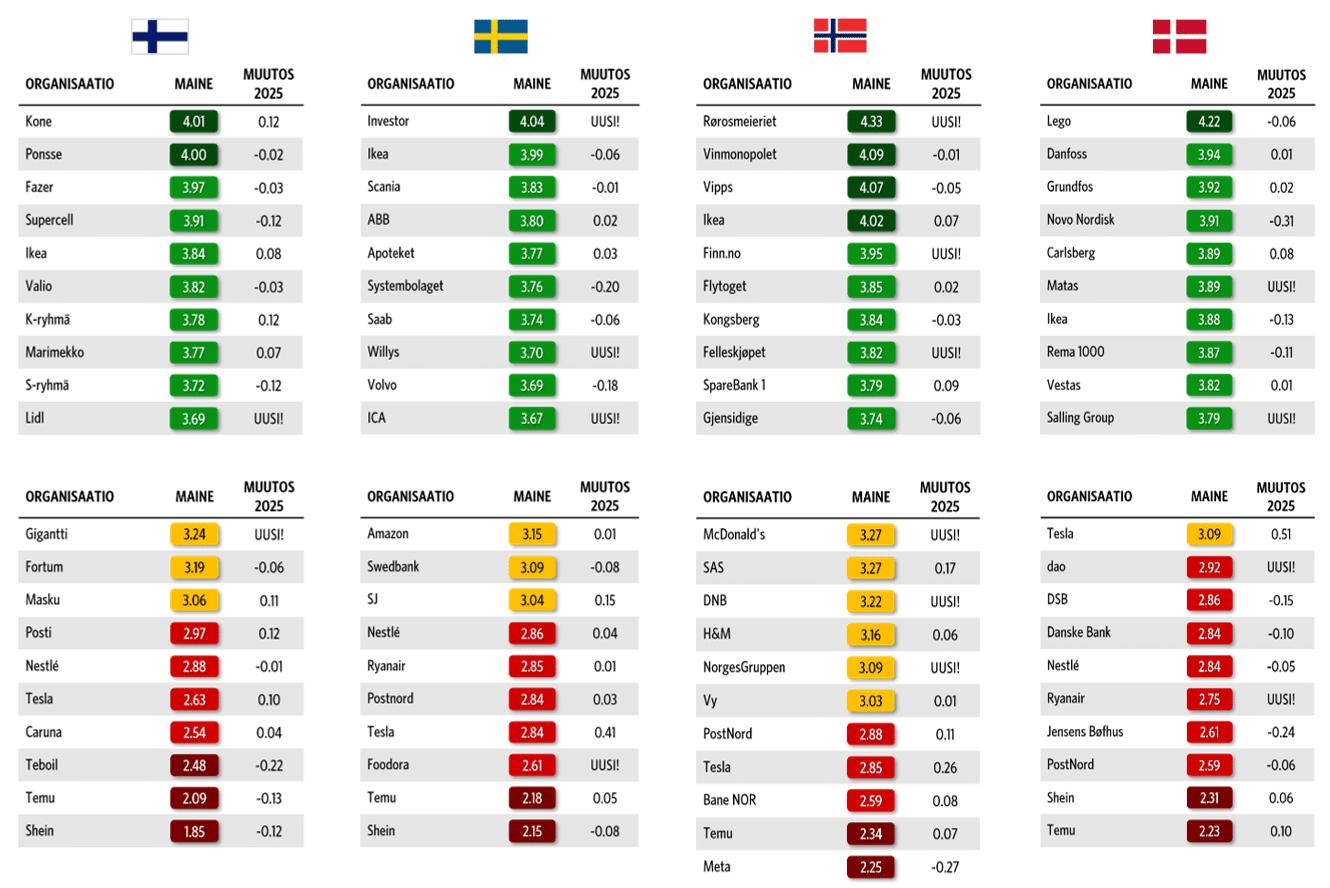
TABLE: Reputation&Trust 2026. Companies with the best and worst reputations in Finland, Sweden, Norway, and Denmark.
Confidence in Tesla's leadership has been restored
A look at the list of companies with the poorest reputations shows that Tesla's sharp decline in reputation has turned into an upturn in all the Nordic countries.
In Finland, Tesla’s reputation rose by 0.10 units, and in all other Nordic countries, the company saw its largest reputation increase of the year. In Sweden, the increase was 0.41 units, and in Norway, 0.26 units. In Denmark, Tesla managed to reach a “moderate” reputation level with a 0.51-unit increase in its reputation score, bringing it to 3.09.
“Tesla’s reputation has begun to recover significantly in the Nordic countries—and even in Germany. In Denmark, Sweden, and Norway, the upward trend is very strong, and it is also significant in Finland. Despite this, Tesla is still viewed as a company with a poor reputation at the Nordic level; only in Denmark has the company managed to achieve a moderately positive reputation,” says Ruokolahti.
“In the Nordic countries, the driving forces behind the restoration of Tesla’s reputation appear to be confidence in the company’s financial performance and the improvement of its image in terms of communication and leadership. The restoration of confidence in Tesla’s leadership can be explained by the fact that the company’s founder, Elon Musk, has been less visible in a political context over the past year,” Ruokolahti assesses.
Finns' trust is built on products and services
Reputation&Trust-The research model explains how trust in an organization is built based on eight components of reputation: corporate governance, finances, leadership, innovation, interaction, products and services, the workplace, and corporate responsibility
“Trust reflects people’s willingness to take risks with regard to a company: whether they want to apply for a job there or invest in it, and whether they want to buy and recommend the products or services it offers,” Ruokolahti summarizes.
“In Finland, the aspect of reputation that has the greatest impact on trust is products and services. In this regard, we Finns are a bit stereotypical: we judge companies more strongly based on their products than other markets do. In Sweden, aspects of social responsibility have the greatest impact, while in Norway and Denmark, environmental responsibility is the most influential factor,” Ruokolahti explains.
Temu and Shein's Reputation Is Worse Than Ever
In Finland’s “ Reputation&Trust ” survey, online retailers Temu and Shein bring up the rear, just as they did last year, with both companies’ reputations having deteriorated further since the previous year. Temu’s reputation score is now 2.09 and Shein’s is 1.85.
“Temu’s reputation in Finland is even weaker than in the other Nordic countries—in Sweden, Norway, and Denmark, its reputation has actually improved somewhat. In Denmark, Shein’s reputation is also on the rise. In this sense, it can be said that Finns are more critical of companies selling ultra-fast fashion and junk than citizens of other Nordic countries,” Ruokolahti notes.
“In all the Nordic countries, however, Temu’s reputation remains very low—below 2.50—unlike in the United Kingdom, for example, where Temu is already approaching a moderately good reputation,” Ruokolahti notes.
This is how we conducted the study
Reputation&Trust The goal of the 2026 study was to assess the reputation of companies operating in the Nordic countries among the general public. Data for the study was collected via an online survey in Finland, Sweden, Norway, and Denmark from May 13 to June 24, 2026.
Organizations were evaluated using Reputation and Trust Analytics’ “ Reputation&Trust ” research model, in which an organization’s reputation score is calculated as the average of eight different subcategories. These areas are corporate governance, finance, leadership, innovation, engagement, products & services, workplace, and corporate responsibility. The study used a five-point rating scale (1–5).
A total of 21,625 people from Finland, Sweden, Norway, and Denmark participated in the study. The study’s target group consisted of citizens aged 15–65 nationwide (excluding the Åland Islands in Finland). The sample was weighted to be representative of the population by gender, age, and region of residence.
The margin of error for the entire data set in Finland is at most about 0.92 percentage points in either direction.
For more information:
Riku Ruokolahti, Reputation and Trust Analytics, Director of Development, +358 400 512 200, riku.ruokolahti@reptrust.com