
Citizens have strong confidence in Finland's university of applied sciences sector, despite the challenges
The " Reputation&Trust 2026" study by universities of applied sciences indicates that the sector’s reputation in Finland continues to decline. There has also been a slight decline in the area of innovation, which is one of the traditional strengths of universities of applied sciences.
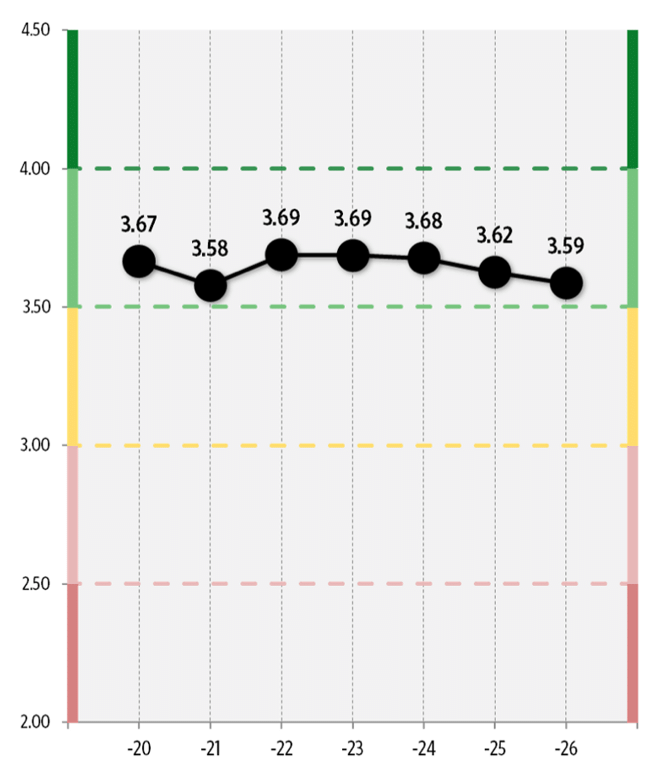
The highest sector reputation score for universities of applied sciences, 3.69, was recorded in 2022 and 2023. Since then, the reputation has been on a downward trend.
In 2026, the sector-specific reputation of universities of applied sciences will receive a rating of 3.59.
“The decline isn’t steep, but it has been steady for a few years now. And while the reputation of universities of applied sciences has declined, the reputation of vocational schools has remained stable, even though they, too, have faced a great deal of external pressure,” says Andrei Sergejeff, senior advisor at Reputation and Trust Analytics .
The reputation of universities of applied sciences has declined the most in the areas of economics and management. This year, a slight decline can also be seen in the areas of products and services as well as innovation, which have traditionally been among the strongest areas of the universities of applied sciences’ reputation.
“Universities of applied sciences have been able to capitalize on their strengths, and their reputation has been shaped in particular by their approach to innovation. However, research universities will have surpassed universities of applied sciences in the area of innovation as early as 2024,” says Andrei Sergejeff.
“There is likely no single reason for the decline in the reputation of universities of applied sciences, and it is understandable that changes are taking place. Fortunately, reputational capital has been built up over the years, so despite the decline, public trust in the UAS sector remains at a very high level. The public continues to hold the products and services of universities of applied sciences in very high regard. So there are tools available to boost our reputation,” Sergejeff continues.
Trends in the Reputation of Universities of Applied Sciences by Field
There are differences within the field—regional universities of applied sciences have improved their reputation
While the sector’s overall reputation is on the decline, several individual universities of applied sciences have succeeded in improving their reputation.
“The reputations of individual universities of applied sciences may differ significantly from the reputation of the sector as a whole. There are noticeable differences in reputation within the sector, and regional universities in particular have done an excellent job of building their reputation and developing their own identity. Regional identity is clearly seen as an important factor in their reputations,” says Susanna Saarenpää, an expert at Reputation and Trust Analytics .
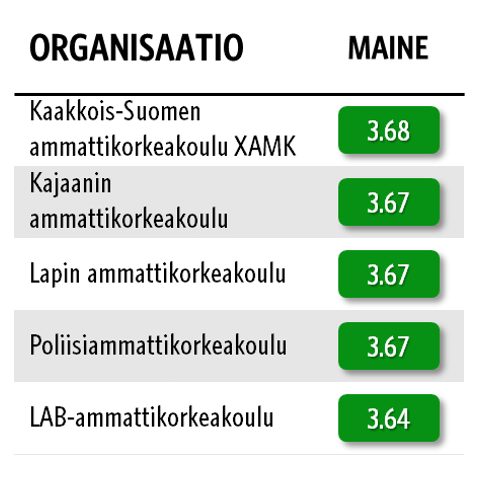
The Southeast Finland University of Applied Sciences (Xamk) was rated as having the best reputation in the study, with a reputation score of 3.68.
Close behind Xamk in the survey were Kajaani University of Applied Sciences, Lapland University of Applied Sciences, and the Police University College, all with a reputation score of 3.67, as well as LAB University of Applied Sciences, with a reputation score of 3.64. The differences are so small that they fall within the survey’s margin of error.
Kajaani University of Applied Sciences saw the biggest rise in reputation in the survey compared to last year.
The Universities of Applied Sciences with the Best Reputations
This is how we conducted the study
The goal of the “Trust & Reputation 2026” survey of universities of applied sciences was to assess the reputation of selected universities of applied sciences among the general public. Data for the survey was collected via an online questionnaire from March 3 to 30, 2026.
Organizations were evaluated using Reputation and Trust Analytics’ “ Reputation&Trust ” research model, in which an organization’s reputation score is calculated as the average of eight different subcategories. These areas are corporate governance, finance, leadership, innovation, engagement, products & services, workplace, and corporate responsibility. The study used a five-point rating scale (1–5).
A total of 5,036 Finns participated in the study. The study’s target group consisted of Finns aged 15–65 nationwide (excluding the Åland Islands). The sample was weighted to be representative of the population by gender, age, and region of residence.
The margin of error for the entire dataset is at most about 1.38 percentage points in either direction.
For more information:
Susanna Saarenpää, Reputation and Trust Analytics, Specialist, +358 40 706 6019, susanna.saarenpaa@reptrust.com
Andrei Sergejeff, Reputation and Trust Analytics, Senior Advisor, +358 50 303 0204, andrei.sergejeff@reptrust.com