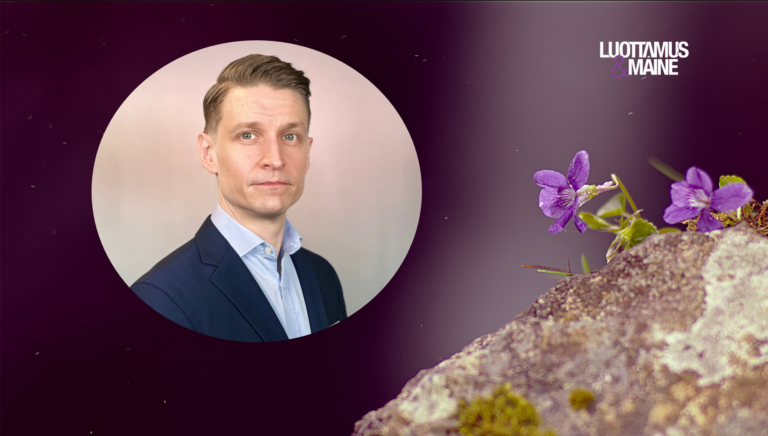
Riku Ruokolahti: “Artificial intelligence gets more out of data when the framework is right—we built our own secure environment for this purpose”
Reputation and Trust Analytics has developed its own AI solution in which open-source models are harnessed to interpret data directly through the Reputation&Trust framework. Since the AI runs on our own, closed infrastructure, the data remains secure and the analyses are precisely tailored to the right context. Riku Ruokolahti, Head of Development, explains why AI performs at its best when clear workflows have been established for it.
Riku, how and why did Reputation and Trust Analytics start developing its own AI?
In 2023, a dream was born: that we could use artificial intelligence to synthesize the quantitative data generated by the “ Reputation&Trust ” model with the open feedback—that is, the qualitative data—collected during the study.
We wanted to take advantage of the opportunities offered by artificial intelligence—on the one hand, to improve our own operations, and on the other, to provide our customers with even greater benefits from the " Reputation&Trust" model.
Right at the beginning of the project, we explored whether we could use any third-party services, but it quickly became clear that this wasn’t really a good fit. We would have had to hand over both the “ Reputation&Trust ” model and our customers’ data to the AI. That’s obviously out of the question. We won’t hand over our most important intangible asset to third parties any more than we would our customers’ confidential information.
So we came to the conclusion that we must have artificial intelligence under our own control and the ability to utilize it under our own wing.
How did the project get started?
We began working to improve the quality of our qualitative data right away in 2023. We redesigned our data collection methods and questions to ensure a richer context for when we eventually get around to putting our dreams into practice.
Next, we began experimenting with various AI models. However, these models—as well as the hardware—are evolving rapidly, which accelerated the development of our own AI solution—but at the same time also posed challenges. We couldn’t really commit fully to any one AI model, since a new and better one might already be just around the corner.
To tackle this challenge, we created a process that we can continuously improve. Thanks to this, we gain access to new, better, more concise, and more effective models as they become available.
Quite a few of our employees have been involved in the AI development project at various stages, but our senior development planner, Jaakko Reinikainen, has done a great deal of the hands-on work.
Where are we headed—what does our own AI look like right now?
I’d say we’re now in a pretty good place with AI. We’ve built the infrastructure, operating models, and processes we need to run local AI models. Our original vision, in which AI combines quantitative and qualitative data, is now working very well. AI efficiently analyzes open-ended feedback through the “ Reputation&Trust ” research model and generates direct recommendations for action based on existing data, supported by quantitative data analysis.
Naturally, the results must be refined, taking into account how they might be reflected in each company’s strategy. Artificial intelligence will not take over the management of the company or its reputation; rather, this intellectual work remains the responsibility of the company’s leadership. However, the results generated by artificial intelligence serve as a solid foundation for the thought process and provide management with interesting insights that could not have been discovered through thought alone.
Artificial intelligence and human thinking therefore each have their own roles to play here, in which they are at their best.
What happens next?
Of course, we’re always keeping an eye on what’s happening in the world and in the field of generative AI.
We continue to follow the two paths we set out on right from the start. The first path is our commitment to developing our own operations using the opportunities offered by artificial intelligence. Second, we are constantly thinking about what new and valuable things we can deliver to our customers with the help of our artificial intelligence.
Artificial intelligence is a particularly appealing tool for us, as we have access to vast amounts of comparable data, and the AI understands the research model on which it is based very well. We conduct our research with the utmost process discipline and precision right from the start of data collection, so we’re in an excellent position to leverage AI. We know and understand what our AI does and how it benefits us.
Riku was interviewed by Anu Räsänen, a communications specialist at Reputation and Trust Analytics.