
The Reputation and Trust in Political Parties in Sweden: A Sign of a Crisis in Public Discourse
In the spring of 2026, Reputation and Trust Analytics measured the reputation of political parties in Sweden and Finland for the first time. The study, *Political Parties’ Reputation & Trust 2026*, shows that public discourse has reached a crisis point.
The study *Political Parties’ Reputation and Trust 2026* used a methodology based on Reputation and Trust Analytics’ research model, Reputation&Trust.
Reputation&Trust is a research model that measures perceptions of an organization across eight sub-areas: governance, finance, leadership, innovation, interaction, democratic accountability, workplace, and responsibility.
“In our study of political parties, the eighth sub-area we measure is the party’s democratic accountability—that is, people’s perceptions of how the party respects the rules of democracy and the democratic process, as well as how sincerely the party strives to build a better society,” explains Riku Ruokolahti, the model’s creator and Director of Development at Reputation and Trust Analytics.
“The study’s findings, then, do not concern the parties’ poll numbers, but rather their reputation among all citizens,” Ruokolahti emphasizes.
The Reputation of Political Parties in Sweden
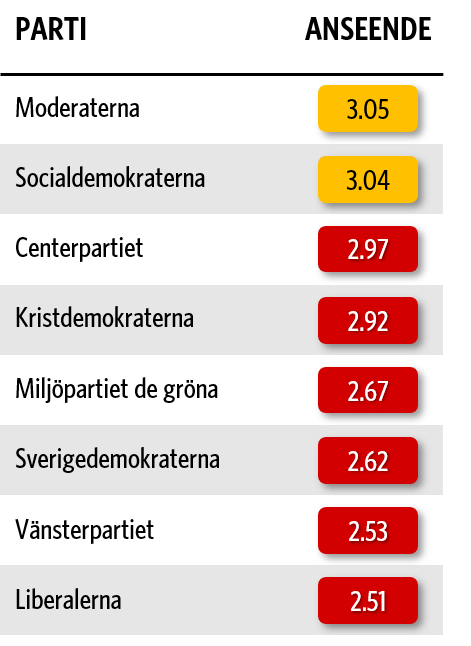
The major political parties have the best reputation in Sweden
The approval ratings of nearly all Swedish political parties are low. Only two parties have approval ratings above the threshold for moderate approval: the Moderates’ approval rating is 3.05 and the Social Democrats’ is 3.04.
On the research model’s five-point scale, an organization’s reputation is considered moderate if its score is between 3.00 and 3.49, and weak if its score is between 2.50 and 2.99.
“The low level of public trust in political parties indicates that the climate of political discourse in the country has become overly heated. The discourse has shifted toward parties publicly criticizing one another rather than articulating their own visions. It is difficult to build a vision for a shared society and address the challenges of the upcoming legislative term when the discourse appears so polarized and lacking in vision,” notes Stefan Wallin, senior advisor at Reputation and Trust Analytics.
The Reputations of Political Parties in Sweden
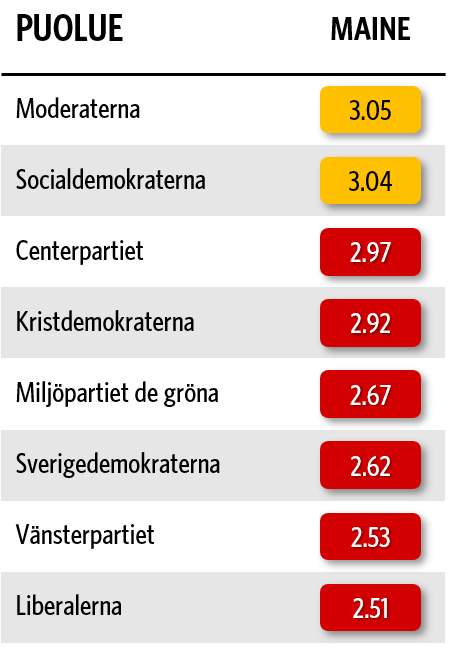
In Sweden, the two major parties have the highest approval ratings
Research findings in Sweden are consistent with those in Finland.
“The reputation of nearly all parties is low, and even those that reach a moderate level only just barely exceed anseende moderate anseende : the Moderates’ reputation score is 3.05 and the Social Democrats’ is 3.04. Of course, unlike in Finland, in Sweden two of the country’s largest parties have a ‘moderate’ reputation,” notes Riku Ruokolahti.
The Sweden Democrats, the sister party of the Finns Party—Sweden's second-largest party—have a reputation score of 2.62.
In addition to questions measuring anseende , the survey asked respondents for their views on whether the party’s existence is important. In Sweden, both the Moderaterna and the Socialdemokraterna parties received high ratings.
“In Finland, these ratings remained at a low or moderate level for all parties.
"There is greater consensus among Swedes that the existence of political parties is important," says Stefan Wallin.
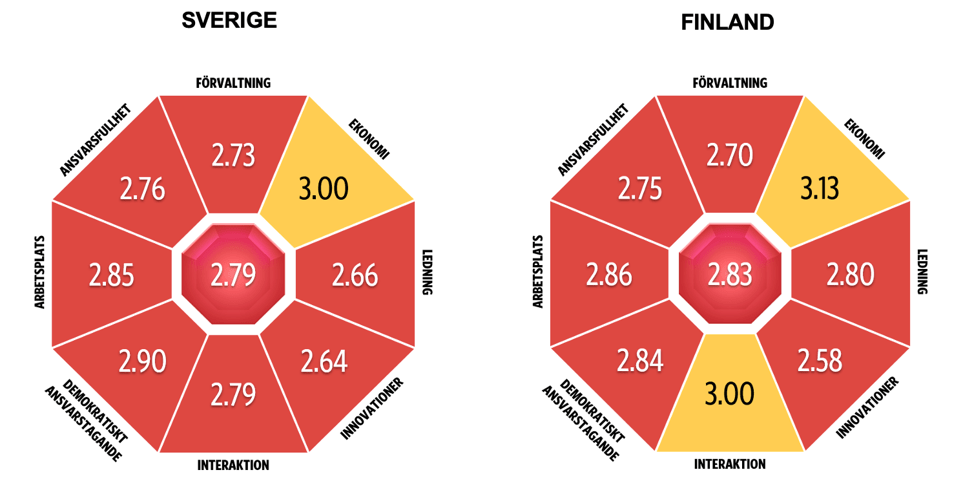
The parties' average approval ratings are low
The average approval rating for all political parties is low in both Sweden and Finland: 2.79 in Sweden and 2.83 in Finland.
“The low scores also have a positive side from a democratic perspective: they show that citizens do not blindly trust political decision-makers and are not afraid to criticize the parties in power,” notes Stefan Wallin.
Here's how we conducted the study
The purpose of the study “Political Parties’ Reputation & Trust 2026” was to assess the reputation of the parties represented in each country’s parliament among Swedish and Finnish citizens. Data collection was conducted via an online survey between April 20 and May 17, 2026.
The parties were evaluated using the Reputation and Trust Analytics research model, “Political Parties’ Reputation & Trust,” in which an organization’s reputation score is calculated as the average of eight subcategories. The subcategories are the organization’s governance, finances, leadership, innovation, interaction, democratic practices, workplace, and accountability. A five-point rating scale (1–5) was used.
The study included 1,562 Swedes who submitted a total of 4,024 organizational evaluations, as well as 2,543 Finns who submitted a total of 4,570 organizational evaluations. The study’s target group consisted of citizens aged 18–74 nationwide (in Finland, excluding Åland). The sample was weighted to be representative of the population by political party based on gender, age, place of residence, and voting behavior.
The margin of error for the entire data set is at most approximately 2.48 percentage points in Sweden and at most approximately 1.94 percentage points in Finland in either direction.
For more information
Riku Ruokolahti, Reputation and Trust Analytics, Director of Development
+358 400 512 200
riku.ruokolahti@reptrust.com
Antti Pennala, Reputation and Trust Analytics, Head of the Data Team
+358 400 375 718
antti.pennala@reptrust.com