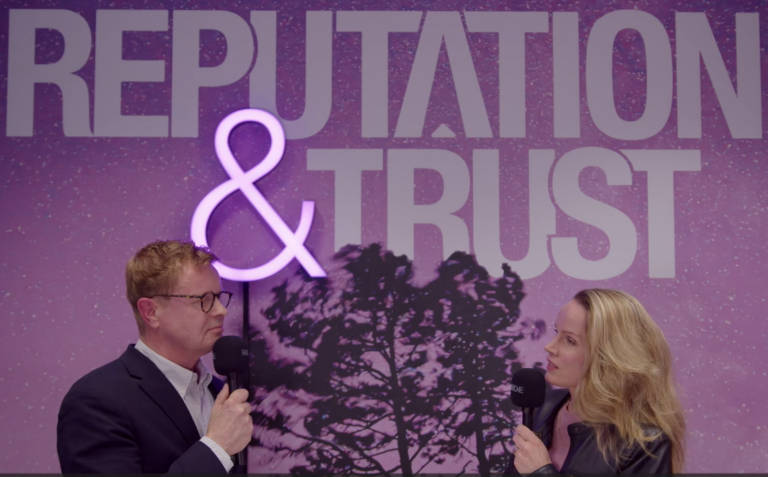
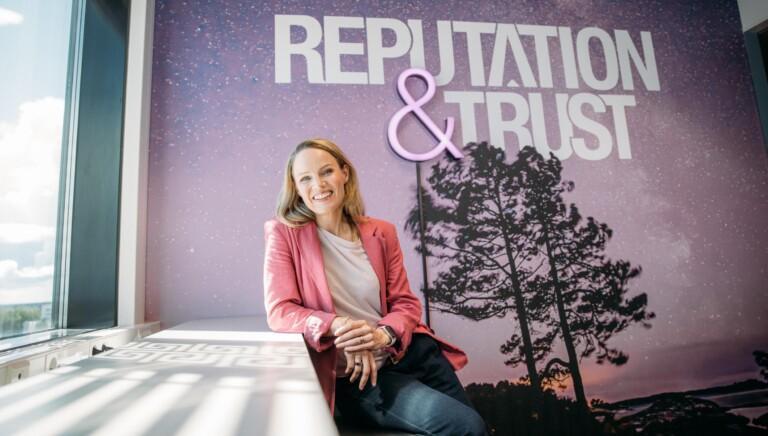
Nina Elomaa: Sustainability and reputation go hand in hand
“A brand that is meaningless, odorless, tasteless, and ‘whatever’ is not viable.”
Nina Elomaa has developed sustainability strategies and management practices for companies and organizations. She believes that global sustainability challenges and the promotion of sustainable development increasingly require a holistic approach and collaboration. Nina serves as the Head of Sustainability at S Group. She has co-authored a handbook on corporate reputation and its management. The article “Sustainability and Reputation Go Hand in Hand,” published here, is taken from the handbook’s third section: “Practical Experiences of Leaders.”
The Human and the Engineer's Perspective on Reputation
I write about my own thoughts and experiences anseende in a company. I am, therefore, acting as an expert by experience. I have not completed any extensive academic degrees on the subject, and what I understand about it, I have learned through my own experience. I have worked in the fields of corporate responsibility, strategy, business management, and—always—with people. So, like Maxim Gorky, I have gained my reputation-related knowledge “in the universities of my youth.”
It is not my intention, in typical Finnish fashion, to underestimate myself or be overly humble, but I do not want to give the impression that my anseende is based on my academic training. In this matter, too, I am simply a human being and an engineer.
The Importance of Corporate Responsibility for a Company
It has been a pleasure and an honor to work in the field of sustainable development or corporate responsibility—whichever term one prefers to use. It’s extremely inspiring, diverse, challenging, and always brings something new to the table—and there are many irons in the fire. The field is incredibly broad, because what area of business doesn’t touch on sustainable development? I personally can’t think of a single one.
It is now very difficult to ignore the importance of sustainable development or corporate responsibility. Global challenges and the growing role of businesses in addressing these challenges are clearer than ever. Legislation, international agreements, and the actions of individuals are all necessary, but without corporate action, progress toward solving these challenges will stall.
Corporate responsibility affects a company’s value, brand, reputation, and many other aspects of its intangible capital. Its importance to a company’s value creation is clear, and for this reason, integrating responsibility into a company’s normal business operations, processes, and strategy is simply sound business management. In fact, it should come naturally to every organization, since isn’t every company’s goal to increase its value? If we link this idea to the concept of making the world a better place—as discussed above—and to the role companies play in this task, there can hardly be any doubt that investing in sustainability is essential.
So what’s so difficult about it, and why not do it? Why isn’t corporate responsibility a natural part of a company’s strategy and a higher priority on executive management teams’ agendas? Why aren’t there more corporate responsibility leaders on executive management teams?
I would argue that the reasons are historical and that sustainability is still viewed as a “soft” issue. It has not been made as concrete as an investment calculation, a sales forecast, or a production plan. The next question is why this is the case, and after that, every sustainability manager would do well to take a long, hard look in the mirror. If the importance and significance of the issue remain unclear, there’s nothing left to do but sit down at the drawing board to identify causal relationships, run calculations, and examine the numbers.
The Joy of Measurement
In business—and in management in general—it is important to be able to produce relevant information, analyses, and figures to support decision-making. In other words, you have to be able to measure things. Someone wise once said that you get what you measure. Or: if you can’t measure it, you can’t manage it, and if you can’t manage it, you can’t improve it.
It sounds like we’re fixated on numbers and data and ignoring other elements of leadership, but there is certainly some truth to those insights. People—and engineers in particular—simply perceive things through numbers, graphs, and trend charts. And we need analysis to support our decision-making.
Measuring corporate responsibility is not easy. Various standards break down corporate responsibility into specific areas, for which metrics can be found relatively easily. But where can one find a metric that would allow for monitoring the overall picture of a company’s corporate responsibility without the number of metrics becoming too large? What correlates with sustainability? What indicates a company’s level of sustainability? What reflects the perception that stakeholders have formed of the company? The answer is reputation.
“What correlates with corporate responsibility? What indicates a company’s level of corporate responsibility? What reflects the image that stakeholders have formed of the company? The answer is reputation.”

Corporate responsibility has a significant impact on a company’s reputation; the correlation is strong. When a company performs poorly in the area of corporate responsibility, trust in it declines, which in turn weakens its reputation. That is why anseende and monitoringanseende is an excellent tool for the strategic management of responsibility. In my experience, reputation metrics are easy to track; they bring concrete data to the executive team’s table; and, above all, they are a number—just like revenue or profit. That is why they are easily understood.
So, is that it then—is this how we’ll get climate change, a company’s environmental impact, and human rights in supply chains under control? Of course not. All the valuable work our colleagues are doing in the field of sustainable development is essential. And there’s still more to be done. But systematically anseende and discussing the importance of responsibility anseende brings responsibility to the top management team’s agenda. Once it’s there, it’s also part of the strategy, and over time, it becomes increasingly integrated into everything we do.

Strategic and Operational anseende
The same logic applies to reputation as to any other manageable matter. Reputation must be made visible so that you can highlight its significance at all levels of the company. In other words, you need to communicate about reputation and its importance, and foster an understanding of everyone’s role anseende and maintaining that anseende .
From an engineer’s perspective, a good approach is to present figures and explain where anseende stand and what our situation looks like. This information must be shared in an understandable format with everyone, while appropriately analyzing the background and reasons for why we are where we are. Once you get the seeds of that logic and mindset to take root, you’ve already accomplished a great deal. This can be achieved through basic management and doesn’t require any special tricks.
It is important to be able to articulate what reputation is, its significance, and everyone’s role anseende and maintaining anseende . The strategic importance anseende for a company cannot be overstated, but it is also extremely important to remember the level and significance of basic operational management. I’ll return to the topic of responsibility as an example.
We have great stories to share about our sustainability efforts, and we want to make them known to everyone. We spread an inspiring message, and our company’s leadership is deeply involved in this work. We talk about our ambitious goals for promoting sustainable development and what we’re committed to as a company—honestly, openly, and transparently. That’s great!
Time passes. Communicating the goal is already behind us, and we need to move things forward. New items come onto the agenda, and there are new messages to convey. At such times, however, it is extremely important to ensure that operational anseende is in order. We cannot lose sight of the day-to-day activities on which the achievement of our goals depends. If we lose our grip at the operational level and the basic management of affairs breaks down, our stakeholders will not understand.

Why do I want to remind you of these basic principles? Because in a world of ever-accelerating change, where ideologies, demands, new aspirations, and sometimes even false assumptions seem to come out of nowhere, it is extremely important to stick to the basics and lead with determination. You can always change course and must always listen to stakeholders, but it is also extremely important to maintain a high standard of operational leadership. This applies to managing responsibility and, by extension, reputation.
The Role and Social Responsibility of Companies and Their Impact on Brand Image
We live in a world where information—good or bad, true or false—moves quickly and is available to everyone. Things are moving at a fast pace, and it feels like there’s an overwhelming amount of everything available. Companies operating at the consumer interface are expected to be present and engage in dialogue 24/7. There is also a growing expectation that they take a stand on the state of the world and on what is appropriate and what is not. Brands are expected to be relevant, and they must have meaning. They must have a point of view and demonstrate their significance through their actions as well.
Over the decades, the role of businesses in society has varied. At times it has been significant, while at other times the focus has been on the importance of other actors. However, this role has always existed, and it is a natural one.
Many of us are currently concerned about the state of the world. We need to be able to solve problems related to the climate, the environment, food security and food production, overconsumption, the economy, and endless growth. We still live in a world where human rights are not fully realized, and man-made crises are ever-present. However, these are issues that can certainly be resolved. Problems and challenges created by humans can be solved by humans.
People are looking for solutions that make their lives easier and that support a better world and its development in a sustainable direction. In addition to high-quality products and services, they expect companies and brands to demonstrate responsibility, conscience, purpose, and a clear stance. And that’s a good thing. Companies must take on their role in bringing solutions to the table and act responsibly. No single party can shirk this responsibility. Everyone needs to do their part.
The brand takes a stand
When a brand starts taking a stand on issues and communicating its views, it always gains supporters. Opinions divide people into different groups. So why take a stand? Wouldn’t it be smarter from a business perspective to be a bit more neutral and leave the statements to others? Just let things be and wait for the world to change? Perhaps one could think this way, but a brand might lose its meaning—it could soon become meaningless, bland, and “whatever” to people. A brand like that won’t last long.
We must therefore accept that taking a stand divides opinion, and consider what is important for the brand and the company, why we exist, and in what direction we want ourselves and the world to evolve. After all, as a company, we are part of society—part of the solution and part of the problem—and that is why we have a responsibility for the state of affairs and the direction things are taking. Even inaction is an action and says something about us to the outside world.
“A brand can, in the blink of an eye, become meaningless, bland, and ‘whatever’ to people. A brand like that won’t last long.”
So we must be prepared to accept feedback—both good and bad—and understand that we can’t please everyone. This isn’t easy. Often, the most heated feedback is the kind that really resonates. Are we really being wise by acting this way, and how does this affect our business and its results? We need to move beyond this line of thinking and focus on why the brand exists, what our company’s purpose is, and what we’re trying to achieve. Returning to these fundamental questions helps dampen that perhaps excessive resonance.
Stances may—and often do—show up in a company’s reputation: some people like them, and others don’t. The reputation meter fluctuates when you take a stand. Fortunately, there’s a metric to track. Fortunately, there’s some analysis that both people and engineers can examine. Fortunately, there are numbers and facts that let you monitor trends in reputation and see how a company’s and brand’s statements resonate with stakeholders. Without a metric, you’d be lost.
On Trust
Trust plays a major role in interactions between people and companies. If you lose trust in a business partner, it is highly likely that you will not want to continue doing business with that partner. Consumers behave in a similar way when deciding whether or not to purchase a company’s products or services. If a consumer feels that a company’s product or service does not live up to its promises, they will likely turn to another provider.
Trust can be lost, and it can be regained through genuine and honest actions. Regaining lost trust is not easy, but it is possible. It is necessary to admit to mistakes—whether intentional or unintentional—and then correct one’s behavior.
In today's global business environment, companies' value chains are long, complex, and intricate.
Value chains sometimes involve a large number of actors, and managing them is extremely difficult. Changes may occur rapidly to ensure deliveries in specific situations, and the parties involved in the chain can change quickly. Despite this, stakeholders expect companies to be aware of their supply chains and to ensure their responsibility and proper ethical conduct in all situations. Whether such a requirement is fair or not is not my place to judge. In any case, this is an expectation placed on companies. You need to know the parties with whom you do business.
At some point in managing these chains, trust comes into play. You can’t control everything, you can’t guarantee everything, and you can’t dictate everything—instead, you have to trust that everyone will operate within the agreed-upon rules. You have to trust. But what happens when things go wrong because someone didn’t follow the rules in your value chain? It’s not enough to say that it didn’t happen on your end and that someone else broke the agreed-upon rules. It’s possible that trust will be shaken and people will feel that you should have known. That’s just how it works—fair or not.
Trust Is Good—But Oversight Is Best?
So when something goes wrong, how can you fix the situation? By increasing oversight? By exercising more control? By changing partners? By compensating the parties for the damage incurred? By changing operating practices? All of these methods can certainly be used—and are used—to rebuild trust. However, I would argue that some of the methods employed do not genuinely impact the environments in which we operate. They do not bring about the change that would be necessary to achieve a lasting, different way of operating. Why is this? Because trust is not fostered through control or supervision, but by delegating responsibility.
Trust is built through good, genuine dialogue and by striving for a level of openness that supports the roles of all parties in the value chain without undermining their ability to operate in the future. Trust is based on the mutual understanding that everyone makes mistakes sometimes, and when mistakes happen, they can be acknowledged and corrected. Avoiding mistakes by increasing control does not build trust; rather, it erodes it, often in a subtle and gradual way.
“Your partners’ reputation affects you, whether you like it or not. So, might it be necessary to also examine your partners’ reputation and hope that they, too, will analyze it?”
Good business practices involve maintaining a certain level of control through sound governance and management systems. It is therefore not possible to operate completely without controls, and we do, after all, have the legislature and the social order to ensure this. Business cannot be conducted entirely without controls. When misconduct occurs at some point and the agreed-upon rules are violated, it is wise to pause and assess what caused it, why such a situation arose, and what the root cause was. It is too easy to jump to the conclusion that supervision and control provide the solution. This can lead to an even worse outcome overall, as it hinders necessary development.
I believe that progress is best achieved through collaboration and by trusting the partners you work with. This means sharing both good and bad news and finding common solutions even in situations where something goes wrong. However, this poses a challenge anseende : your partners’ reputations affect you, whether you like it or not. So, might it be necessary to also examine your partners’ reputations and hope that they, too, analyze theirs?
Five Tips for anseende
1. Understand reputation as a form of value capital.
2. Manage your reputation just as you would anything else.
3. Measure your reputation regularly and analyze the results. Draw conclusions based on the data.
4. Put reputation on the agenda for executive and team meetings.
5. Share information about reputation and the results of reputation measurements both internally and externally.
[button url=”https://reptrust.com/pari-sanaa-maineesta-elomaa/” size=”btn-md” style=”btn-primary” target=””]WATCH NINA’S INTERVIEW[/button] [button url=”/luottamus-maine/” size=”btn-md” style=”btn-secondary” target=””]Learn more about the “ Reputation&Trust ” model[/button]