The social and health care sector’s reputation continues to improve in Finland – HUS saw the biggest improvement in its reputation
Reputation and Trust Analytics’ “ Reputation&Trust , 2026” study on the social and health care sector indicates that the sector’s rise in reputation, which began last year, is continuing. Of the organizations surveyed, Coxa Joint Replacement Hospital has the best reputation, and HUS saw the greatest improvement in its reputation.
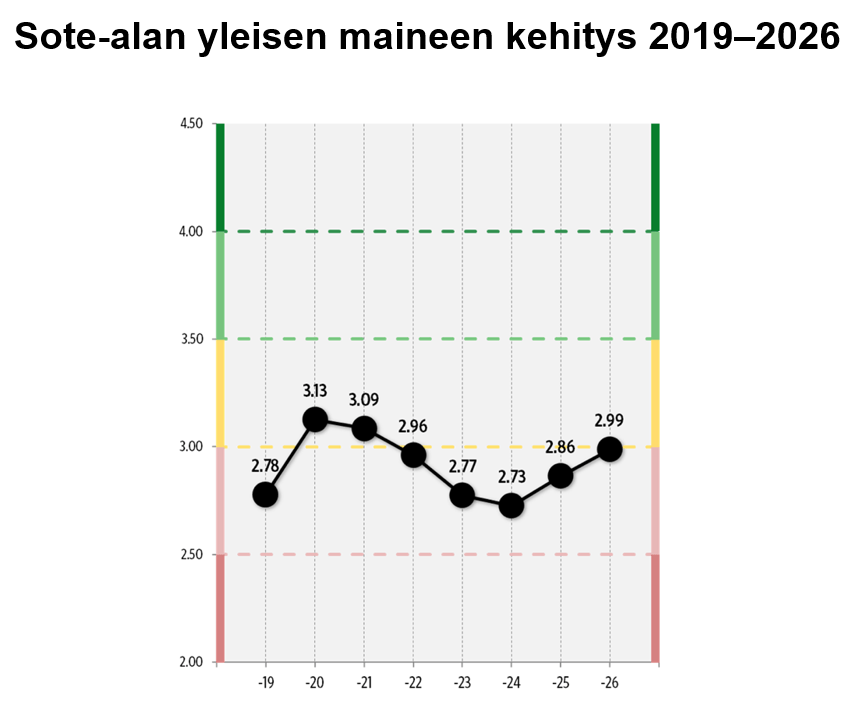
The overall reputation of the social and health care sector was on a downward trend from the first year of the pandemic, 2020, through 2024, when the sector’s reputation reached its lowest score in the history of the survey, 2.73. The downward trend reversed last year: the sector’s reputation score rose by as much as 0.13 points to 2.86 in 2025 and by another 0.13 points to 2.99 this year.
This year’s reputation score of 2.99 for the social and health care sector is just one hundredth of a point away from a “moderate” reputation. On the five-point scale of the “ Reputation&Trust ” research model, an organization’s reputation is considered moderate if its reputation score falls between 3.00 and 3.49.
“It is significant that the multi-year decline has come to a halt and anseende has reversed to an upward trajectory. The improvement in the social and health care sector’s reputation has even continued at a steady pace. This indicates that the sector’s consistent efforts have begun to yield results,” says Kai-Verneri Kaksonen, Public Relations Manager at Reputation and Trust Analytics.
HUS Has Improved Its Reputation the Most
In addition to the overall reputations of the social and health care sector and the public and private sectors, the study measured the organization-specific reputations of 41 industry players. Respondents rated Coxa Joint Replacement Hospital as having the best reputation, with a reputation score of 3.87.
The largest increase in reputation, 0.19 units, was recorded by a public-sector organization, Helsinki University Hospital (HUS).
“HUS also saw the largest single increase in any reputation dimension across the entire survey data set: 0.31 units in the workplace subcategory. For the first time in the survey’s history, the organization succeeded in improving its employer image—and by a significant margin,” says Kaksonen.
“The management category is often challenging in the public sector, but HUS has improved its score there as well, by as much as 0.29 units. In addition, HUS has seen a 0.22-unit increase in the administration category and a 0.21-unit increase in the finance category. These categories are intertwined in the broader discussion: developments in finance and administration often also influence perceptions of leadership,” Kaksonen continues.
HUS’s improved reputation has also been reflected in increased support from its stakeholders.
“HUS’s reputation has been rising rapidly for the second year in a row. It is particularly gratifying that positive developments have taken anseende areas. Overall, the results show that we have succeeded in maintaining and building trust across the board, even during these difficult years of restructuring,” says Matti Bergendahl, CEO of HUS.
This is how we conducted the study
The goal of the “ Reputation&Trust 2026” survey on the social and health care sector was to assess the reputation of selected organizations in the social and health care sector and the sector’s overall reputation among the public. Data for the survey was collected via an online questionnaire from March 17 to April 21, 2026.
Organizations were evaluated using Reputation and Trust Analytics’ “ Reputation&Trust ” research model, in which an organization’s reputation score is calculated as the average of eight different subcategories. These areas are corporate governance, finance, leadership, innovation, engagement, products & services, workplace, and corporate responsibility. The study used a five-point rating scale (1–5).
A total of 6,686 Finns participated in the study. The study’s target group consisted of Finns aged 15–65 nationwide (excluding the Åland Islands). The sample was weighted to be representative of the population by gender, age, and region of residence.
The margin of error for the entire dataset is at most about 1.20 percentage points in either direction.
For more information:
Kai-Verneri Kaksonen, Reputation and Trust Analytics, Public Relations Manager, +358 50 545 5421, kai.kaksonen@reptrust.com
Riku Ruokolahti, Reputation and Trust Analytics, Director of Development, +358 400 512 200, riku.ruokolahti@reptrust.com