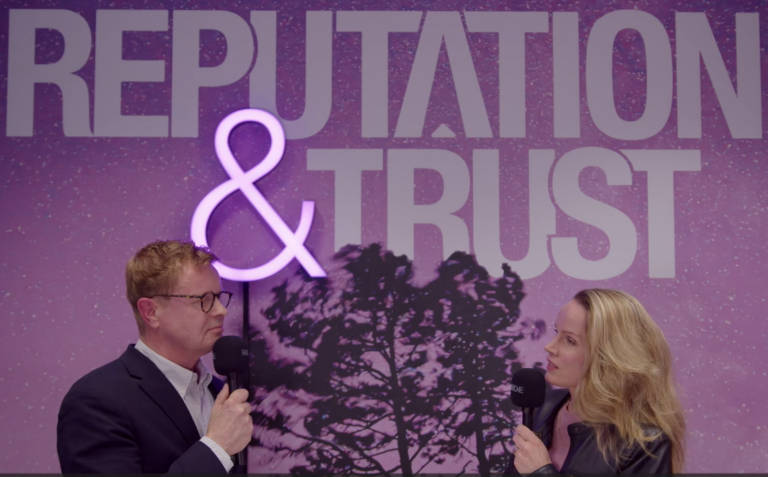
Recording of the webinar: "ESG and Corporate Reputation as Drivers of Sustainable Growth and Shareholder Value"
The first event of T-Media’s anniversary year focused anseende of ESG and anseende on a company’s shareholder value, investor behavior, customer recommendations, and workforce availability. The entire event is available as a recording below.
[button url=”https://www.webcasting.fi/esg-ja-yhtion-maine-kestavan-kasvun-ja-omistaja-arvon-rakentajana/” size=”btn-md” style=”btn-primary” target=””]Watch the webinar recording[/button] [button url=”/wp-content/uploads/2022/02/ESG_and_Reputation_webinar_02022022_presentation_materials.pdf” size=”btn-md” style=”btn-secondary” target=””]Download the webinar presentation materials[/button]
The joint webinar hosted by Boyden and T-Media focused on ESG and anseende , as well as concrete ways in which a board of directors can guide a company on these issues. ESG refers to issues related to companies’ environmental and social responsibility as well as corporate governance; the acronym stands for Environmental, Social, and Governance.
The panel discussion during the webinar featured Leena Mörttinen, Under-Secretary of State for International and Financial Market Affairs at the Ministry of Finance; Lasse Heinonen, CEO of Ahlström Capital; Tero Hemmilä , CEO of HKScan ; and Jaakko Hirvola, CEO of Technology Industries of Finland.
The data demonstrates the effectiveness of sustainability efforts
At the start of the webinar, Harri Leinikka, CEO of T-Media, explained—based on the company’s decade-long data analysis—how strongly reputation and sustainability issues influence people’s behavior.
“This is the tenth year that we have been evaluating organizations using the ‘Reputation&Trust ’ model in Finland and around the world. We have been able to quantify the impacts of reputation, identify ESG themes within it, and calculate their impact.”
“When we first introduced the ‘ Reputation&Trust ’ model, our typical clients were sustainability and communications directors. Today, the results are almost always discussed in executive teams and, increasingly, are also presented to boards of directors—there is a desire to understand and monitor issues critical to business operations more closely than before,” Leinikka emphasized.
Leinikka presented an ESG index—created using T-Media’s database—for 60 Finnish companies. The index score for this basket of companies, which represents several industries, has not yet risen above a “good” rating during its ten-year history of measurement.
“The index hasn’t yet risen above a ‘good’ rating. There’s still a bit of work to be done there. However, we have many examples showing that good sustainability work also pays off financially. For example, Kesko and Valmet have managed to surge far above the index average and move into the ‘green’ category in their own ESG index, while increasing their profitability.”
The Role of Corporate Responsibility in Strategy, Regulation, and Recruitment
In a panel discussion led by Carita Lahti, Managing Partner at Boyden, participants shared their experiences and insights anseende ESG management, including metrics, frameworks, and the impact of regulation.
Hemmilä of HKScan said that it is important to know how to measure relevant issues. The impact of sustainability on the income statement and balance sheet must be understood within the company: “First, we need to understand that sustainability is part of our strategy. The next step is to understand that sustainability is the foundation of our strategy.”
Leena Mörttinen, for her part, said that it is the private sector’s responsibility to communicate its own reality as clearly as possible to policymakers who are considering regulations for the sector.
“We are in a more politicized economy. No one expects the markets to solve the fight against climate change; instead, regulation is being used to find a solution and accelerate the process. Regulation puts enormous pressure on companies to clearly communicate their reality.”
Lasse Heinonen of Ahlström Capital has come across several studies on potential employees’ interest in ESG.
“There is already a lot of data showing how important sustainability is in retaining current employees and recruiting new ones,” Heinonen said.
“Speaking from my own professional experience, I have to say that younger people—those under 45, regardless of their role—ask about the company as background information: how corporate responsibility is integrated into the company and how it is reflected in its functions and business operations,” Carita Lahti continued.
Jaakko Hirvola of the Technology Industry Association observed that environmental challenges are driving significant global demand for responsible business practices:
“There is a huge business opportunity in meeting global demand now that we must stop climate change. If Finland is carbon-neutral by 2035 and Europe by 2050, we have a 15-year head start. We should take advantage of this and capture the global market. This requires data, digitalization, streamlining, and improved productivity.”
For more information
Harri Leinikka, CEO
harri.leinikka@reptrust-staging.fi-p.seravo.com, +358 40 505 5001