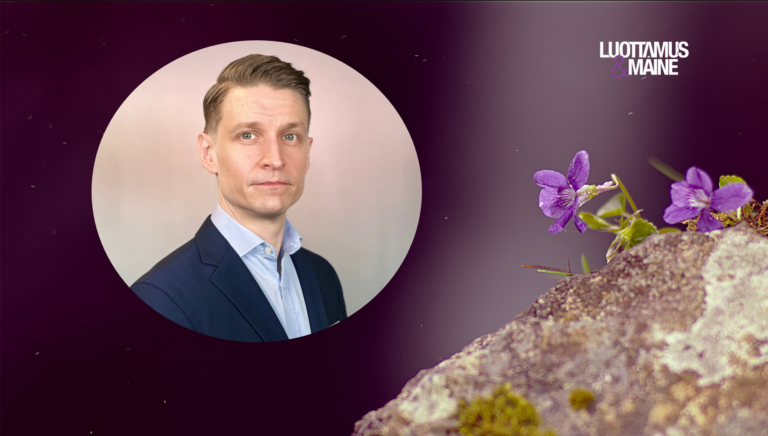
Jorma Mikkonen: Roots in Finnish Society
Jorma Mikkonen has made it his life’s mission to transform society into a sustainable circular economy. Jorma has served this mission in a variety of leadership roles in business operations, public relations, corporate responsibility, and communications and branding.
The story of Lassila & Tikanoja is a colorful one. The company has evolved from a wholesaler through the apparel industry and a phase as a diversified conglomerate to its current role. It has weathered industrialization, war and reconstruction, the collapse of trade with Russia, and globalization. L&T has been a key player in Finnish society for 115 years.
As a result of the major social reforms that took place during this period, the relationship between society and businesses, as well as their respective roles, have been in a state of constant flux. The struggle between the socialist and capitalist systems ended in a compromise, and this is how the Nordic welfare state model was built. The public sector took on many responsibilities, and the social role of businesses remained limited. Businesses focused on maximizing shareholder value and sought economies of scale in increasingly globalized markets through globalization.
I have been involved in the development of Lassila & Tikanoja since the early 1990s—that is, for nearly 30 years. Concerns about climate change and the challenges of sustainable economic growth have been on the official agenda throughout this time and will remain there until the end of my career. Governments and the political system have not been able to find effective solutions to mitigate climate change.
The public sector has taken on too many tasks, and its core mission has become blurred. New solutions are being sought for major societal challenges, such as an aging population, urbanization, rising social exclusion and inequality, and the refugee crisis. The accumulation of sustainability challenges has laid the groundwork for the growth of the social role of businesses. Faith in the political system has wavered, and citizens have begun to expect businesses to play a stronger role in solving societal challenges.
L&T’s growth into a leading player in the circular economy sector has taken place in a piecemeal fashion through numerous acquisitions. As we entered the 2010s, we were providing largely the same services we do today. The company did not have a strong mission or identity; rather, we were a fairly faceless provider of support services. Starting from this point, we began to revamp the L&T brand in 2012.
The mission to make the world a better place put social issues at the heart of the company
Amid growing sustainability challenges, L&T employees were doing important and sustainable work. There was therefore no cause for any kind of identity crisis. We simply hadn’t found the right way to highlight the significance of our work. When we then adopted the mission of transforming the consumer society into a sustainable circular economy, the contrast with the past was enormous. The new mission required us to play a significantly more active role in societal discourse and in the development of new service solutions.
With our new mission, the importance of sustainability issues also came into sharper focus. Driven by curiosity, we joined sustainability networks to learn how larger companies were advancing their sustainability efforts. We’ve been on this path for nearly ten years now, and we have a strong desire to grow and innovate our operations. We have learned a great deal about the new three-letter sustainability standards, which are intended to guide a company’s operations in the right direction. At the same time, however, they tie up the company’s resources in massive reporting efforts.
Within corporate responsibility networks, there was a discussion about how corporate responsibility is something deeper than just anseende . We never really understood this at any point. Our approach, both in brand building and in sustainability work, has been that our mission is to help our clients achieve sustainable development. Our solutions promote our clients’ sustainability, and that’s why all of this is automatically very strategic.
Only by increasing stakeholder value can we create shareholder value
The team at T-Media taught us that emotions drive behavior. This is perhaps the most valuable lesson we’ve learned for our own development. We conducted comprehensive stakeholder analyses, which provided us with valuable insights into the direction in which the company’s strategy and operations should be developed. Stakeholders expect companies to provide solutions to major societal challenges, such as climate change, refugee crises, social exclusion, and inequality. The growing expectations of our stakeholders guide our choices and expand our role in society.
The message from our stakeholders is clear: We are on the right track. People want us to take bold initiatives and innovate, to engage in open dialogue, and to pursue fair and equitable human resources policies—and, above all, to provide solutions to pressing societal challenges. This is how a service company begins to evolve into a guardian of society’s functioning—or even a force driving society forward. Megatrends are the underlying forces at play, but stakeholder expectations evolve in real time. For example, right now during the COVID-19 pandemic, the importance of hygiene safety is being emphasized, and this importance may become permanent. We develop solutions that safeguard the functioning of our customers, our staff, and, through them, society as a whole.
In the fall of 2019, L&T incorporated sustainability goals into its long-term strategic objectives for the first time, placing them on par with its financial goals. This embodies the idea that, in order to succeed, we must be able to create value for our customers, our employees, and society. When we succeed in this, shareholder value also grows. Increasing shareholder value has shifted from being the starting point of our operations to being a consequence of them.
Emotions guide stakeholder behavior. Reputation is strongly correlated with stakeholder support. anseende is therefore a highly strategic activity.
Riku Ruokolahti has written a handbook on corporate reputation and its management. The chapter published here, written by Jorma Mikkonen and titled “Roots in Finnish Society,” can be found in the third section of the handbook: “Practical Experiences of Leaders.”
[button url=”/trust-reputation/” size=”btn-md” style=”btn-primary” target=””]Learn more about the “ Reputation&Trust ” model[/button] [button url=”https://reptrust.com/maineen-johtamisen-kasikirja-tilaus/” size=”btn-md” style=”btn-secondary” target=””]Order the handbook[/button]